European Patent

Overview
Patent protection in Europe – we'll guide you through it
Looking for protection for your solution in more than one European country? Then get to know how the European patent works! At EUPATENT Patent Attorneys, we will help you take care of all the necessary formalities.
Created an invention? Don’t forget to patent it
As a rule, patents are granted by national offices, and their protection covers the territory of a single country – the EUROPEAN PATENT is the notable exception. If you are looking for protection for your solution in more than one country, it may be the right choice for you.
Get a patent that protects you across Europe
The European patent is granted by the European Patent Office (EPO), headquartered in Munich (www.epo.org), on the basis of the European Patent Convention (EPC). It allows you to obtain protection for an invention in the 40 EPC contracting states.

Key facts about European patents
Service scope
What we offer
handling European patent grant proceedings
handling opposition proceedings against granted European patents
handling appeal proceedings against decisions issued by the EPO in European patent cases
Service details
What else should you know?
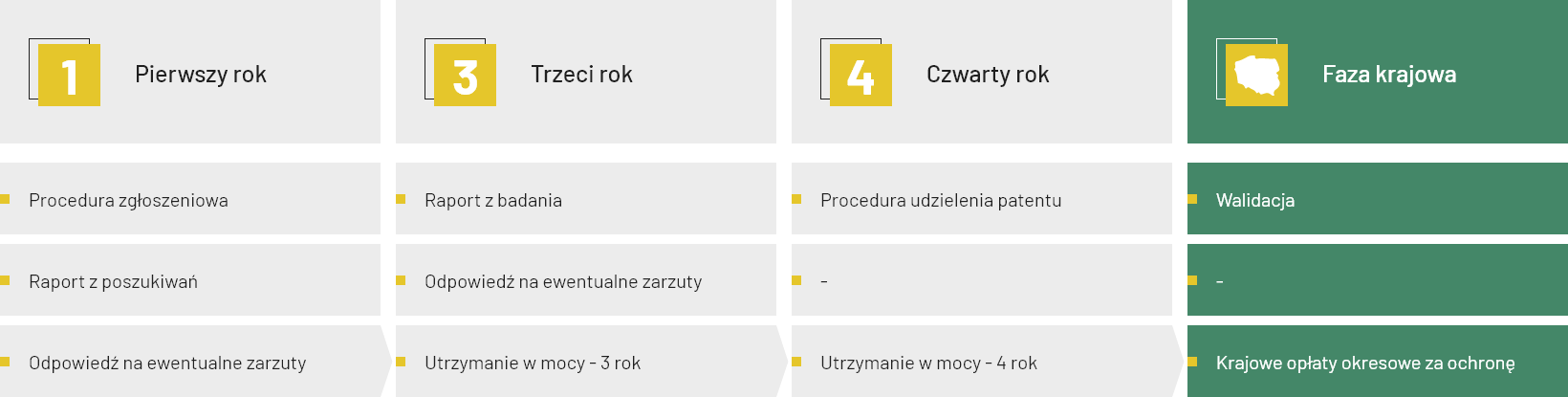
Grant proceedings follow a harmonized procedure before the European Patent Office (EPO). Once the EPO has decided to grant the patent, the patent owner carries out the so-called validation procedure in the countries where the European patent is to be protected. Because of the fees involved, most European patents are kept in force in only some of those countries.
Obtaining a European patent takes about 3-4 years from the filing date. How long it takes depends on the complexity of the case and the number of similar solutions cited by the examiner.
Stages of the procedure before the European Patent Office
Contact
Need help with this?
Interested in a European patent? Write to us and prepare a list of the issues you would like to discuss – we will develop a solution tailored to your needs
FAQ
Frequently asked questions
Both are granted under the same EPO procedure – the difference appears only after grant. A classic European patent "splits" into a bundle of national patents, which must be validated and paid for separately in each country. The Unitary Patent is a single right covering 18 EU countries at once, with one renewal fee and a common court (the Unified Patent Court, UPC). Note: the Unitary Patent covers neither Poland (which has not joined the system) nor non-EU countries such as the UK or Switzerland – there, classic validation is still required.
The biggest advantage is a single application instead of a dozen or more separate national filings – you file in one language and go through one examination. A European patent is examined thoroughly, so once granted it is "strong" and harder to challenge. It pays off especially when you care about protection in several countries (usually 3-4 or more). Another big plus is flexibility: you choose the countries where you actually want to protect your invention later – only after the patent is granted and you have reviewed the examination results.
EPO official fees alone – from filing to grant – typically total around EUR 5,000–10,000 in a standard case (including a search fee of approx. EUR 1,595 and an examination fee of EUR 2,010; most fees rose by about 5% on April 1, 2026). Extensive applications can cost more. Attorney fees come on top of that. The total cost of obtaining a European patent may reach around EUR 10,000–20,000. After grant, you pay for validation (translations, national fees) and renewal fees that increase every year – separately in each country. The overall cost therefore depends mainly on the number of countries you choose; smaller entities and universities are entitled to fee reductions.
The EPO's official languages are English, French, and German – proceedings are conducted in one of them. You can file the application in any language (including Polish), but a translation into one of the three official languages must then be provided; Polish applicants receive a fee reduction for doing so. Before grant, the claims are translated into the other two official languages. After grant, at the validation stage, some countries additionally require a translation into their national language – although the so-called London Agreement has significantly limited this requirement.
Not only the European Union. The European patent is based on the European Patent Convention (EPC), which currently has close to 40 contracting states – including non-EU countries such as the United Kingdom, Switzerland, Norway, and Turkey. Protection can additionally be extended to several so-called validation states (including Morocco, Tunisia, Georgia, and Cambodia). Remember, though, that it is not a single patent "for all of Europe" – after grant, you decide in which countries you bring the patent into effect and maintain it.
Validation covers the formalities that make a granted European patent effective in a specific country. The EPO grant alone is not enough – in each chosen country, you usually have to file the required translation, pay a fee, and sometimes appoint a local representative. You generally have 3 months from the date the mention of the grant is published; after that deadline, protection in that country is lost. The alternative is the Unitary Patent, which does not require separate validation in 18 EU countries.
The EPO does not publish a single "guaranteed" figure, but in recent years the share of applications ending in a granted patent has stayed above 50%. Keep in mind that this is an aggregate statistic – it also includes weak applications and applications abandoned along the way. The real chances of a specific application go up if you first carry out a thorough prior art search and prepare the description and claims with care. Good preparation matters more here than the statistical average.
In Europe, there is practically no "grace period". Any public disclosure before the filing date – a demonstration, a sale, an article, a website post, a conference presentation – as a rule destroys novelty and closes the path to a patent. The exceptions are very narrow (e.g. an evident abuse against the applicant). Hence the iron rule: file first, disclose later. This is a common trap for startups doing a "soft launch" and for scientists publishing their results too early. In the US, by contrast, there is a 12-month grace period – you can obtain a patent for a solution disclosed before filing.
Yes – a great many solutions in this field are patentable. Only programs or mathematical methods that have no technical application at all cannot be patented. If software solves a specific technical problem and produces a technical effect, it can be patented – even if it runs on an ordinary computer or smartphone.
Three basic ones. First, novelty – the solution must not be previously known or publicly disclosed anywhere. Second, an inventive step – the solution must not be obvious to a person skilled in the art; the EPO assesses this using the "problem-solution approach", comparing the invention with the closest prior art. Third, industrial applicability. In addition, the invention must have a technical character and must not fall within the excluded categories (e.g. mere discoveries or business methods).